How to Build a Daily Drawing Habit (Even with No Time)
There’s a quiet frustration many people feel when it comes to drawing.
You want to draw more. You save ideas, buy sketchbooks, maybe even start strong for a few days… and then life takes over. Work, kids, responsibilities, mental load. Suddenly, drawing becomes “something you’ll get back to later.”
But here’s the truth most advice skips:
You don’t need more time. You need a better system.
This guide shows you exactly how to build a realistic, sustainable daily drawing habit—even if your schedule feels completely full.
Why Most Drawing Habits Fail
At first glance, building a drawing habit seems straightforward.
You decide to draw every day, you feel motivated, you start strong… and then something shifts. A busy day interrupts your routine, or you feel too tired, or the drawing itself suddenly feels harder than expected.
What most people don’t realize is that the problem isn’t consistency.
The problem is the way the habit is designed.
Many drawing habits fail because they are built on unrealistic expectations from the very beginning. People often aim too high, too fast. They set goals like filling full sketchbook pages, practicing for 30 minutes daily, or creating something “good” every time they sit down.
This creates pressure.
And pressure makes habits fragile.
The moment your day becomes slightly more demanding than usual, the habit feels like extra work instead of something that fits naturally into your routine. That’s when skipping “just one day” becomes skipping a week.
Another hidden issue is the lack of clarity.
What does “drawing every day” actually mean?
For some, it means a finished piece. For others, it’s a few lines. Without a clear definition, your brain treats the task as open-ended, which makes it easier to avoid.
Finally, most people rely heavily on motivation.
But motivation is unreliable.
It fluctuates based on energy, mood, and external stress. If your habit depends on feeling motivated, it will always break at some point.
That’s why the key to a lasting drawing habit is not doing more.
It’s making the habit so simple, so clear, and so easy to start that skipping it feels harder than doing it.
The Core Principle: Make It So Easy You Can’t Skip It
If a habit feels heavy, your brain will resist it.
This is not laziness. It’s efficiency.
Your brain is constantly trying to conserve energy. If something feels demanding, unclear, or time-consuming, it automatically looks for reasons to delay or avoid it.
That’s why the most effective drawing habits don’t start with ambition.
They start with reduction.
Instead of asking, “How can I draw more?”, the better question is:
👉 “What is the smallest version of drawing I can do every single day?”
This shift changes everything.
Because once the barrier to starting becomes extremely low, consistency becomes possible.
And consistency is what builds skill.
Not intensity.
Not perfection.
Just repetition over time.
Step 1: Define Your “Minimum Version”
Your minimum version is the foundation of your habit.
It defines what counts as success on your worst, busiest, most chaotic day.
This is important, because habits don’t fail on good days.
They fail on difficult ones.
A strong minimum version could look like this:
- Drawing one simple shape
- Making a quick doodle
- Practicing a few lines
- Sketching a tiny object
It might feel almost too small.
That’s exactly the point.
Because the goal here is not improvement in the beginning.
The goal is consistency without resistance.
Once you remove the pressure to perform, showing up becomes easier. And once showing up becomes automatic, improvement follows naturally over time.
Step 2: Use Micro Time Windows Instead of “Finding Time”
One of the biggest misconceptions about habits is the idea that you need to find time for them.
In reality, most people don’t have large empty blocks waiting to be filled.
What they do have are small, often unnoticed moments throughout the day.
These moments are powerful.
Because they already exist.
Instead of trying to create time, you attach your habit to these existing windows.
For example:
- While your coffee is brewing in the morning
- Right after brushing your teeth
- While waiting for food to cook
- During a short quiet moment in the evening
These are not interruptions.
They are opportunities.
By linking drawing to something you already do daily, you remove the need to remember or plan. The habit becomes part of a sequence, not a separate task.
This is what makes it sustainable.
Step 3: Build a Routine That Feels Effortless
A good routine is not complicated.
It doesn’t require decisions, preparation, or mental energy.
It should feel almost automatic.
A simple daily drawing routine could look like this:
- Open your sketchbook
- Draw something small
- Stop before it feels exhausting
Stopping early is important.
It leaves you with a sense of ease instead of fatigue. And that makes it easier to return the next day.
Many people push too far, trying to “make the most” of their time. But this often leads to burnout, even in small habits.
Consistency grows faster when the habit feels light.
Step 4: Mini Exercises That Build Real Skill
Once your habit is stable, you can start adding structure.
Not complexity. Just direction.
Mini exercises are perfect for this because they are:
- Quick
- Repeatable
- Focused
Here are a few that work extremely well:
Shape Practice
Instead of drawing complex objects, focus on basic forms like circles, squares, and triangles.
Take your time to draw them cleanly and evenly.
This trains your control and builds confidence with your lines.
Line Flow Exercise
Fill a page with different types of lines:
- Long curves
- Soft waves
- Parallel strokes
Try to keep them smooth and consistent.
This improves your hand movement and helps you develop a natural drawing rhythm.
Everyday Object Sketches
Pick something simple from your environment:
- A mug
- A spoon
- A plant leaf
Draw it quickly without overthinking.
This builds observation skills and makes drawing feel connected to real life instead of abstract practice.
Realistic Time Models That Actually Work
Not every day looks the same.
That’s why your habit needs to be flexible.
Here are three realistic time models you can use:
The 2-Minute Day (Busy Days)
You do the absolute minimum. One tiny drawing. Done.
The 5–10 Minute Day (Normal Days)
You do a small exercise or a quick sketch.
The 20+ Minute Day (Free Days)
You go deeper, experiment, or work on something bigger.
All three count equally.
Because consistency matters more than duration.
How to Stay Consistent Without Burning Out
Consistency is often misunderstood as something that requires more effort, more discipline, or more pressure. In reality, it works in the opposite direction. The more resistance your habit creates, the harder it becomes to maintain. That’s why long-term consistency is not about pushing yourself harder every day, but about making the process as smooth and effortless as possible.
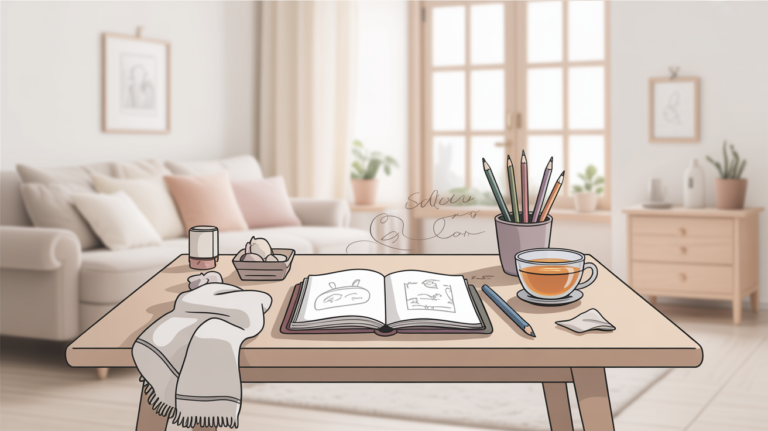
Small adjustments can make a huge difference. Keeping your sketchbook within reach instead of tucked away removes the first barrier to starting. Preparing your tools in advance means you don’t have to think before you begin. Allowing your drawings to be imperfect takes away the pressure that often causes hesitation. And most importantly, letting go of the idea that you need to “catch up” after missing a day prevents the habit from turning into a burden.
Because missing a single day doesn’t break your progress. It’s a normal part of any routine. What truly interrupts a habit is the moment you stop returning to it.
So instead of trying to compensate or do more, focus on something much simpler. Just come back to it. Again and again. That’s what keeps the habit alive.
Build Your Daily Drawing Habit That Lasts
A daily drawing habit doesn’t come from sudden discipline or short bursts of motivation that disappear as quickly as they come. It develops much more quietly, almost unnoticed at first, through small actions that you repeat again and again in the middle of your everyday life. It takes shape in routines that don’t compete with your schedule but gently fit into it, in simple moments where you decide to pick up a pencil even when it would be easier to skip it.
Over time, something begins to shift. What once felt like effort slowly turns into something familiar. Drawing no longer feels like a task you have to plan or push yourself to do. It becomes a natural part of your day, something you return to without overthinking it. And that’s exactly the point where real progress starts to happen, almost as a side effect of showing up consistently.